Monday, May 18, 2015

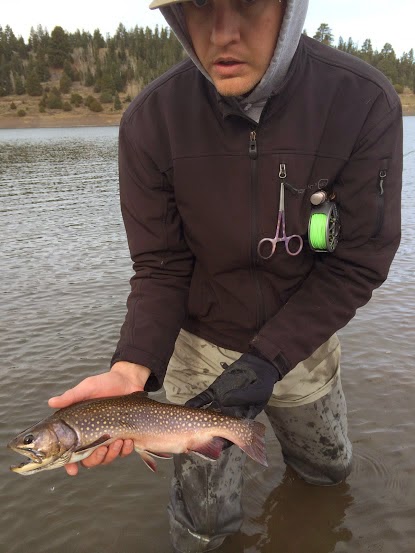
Tips for Catching Bigger Trout

   There came a point in my fishing where I could consistently catch fish.  My casting was pretty good, presentations were decent, and I was hooking up.  I enjoyed it and spent a lot of time on the water.  I learned a ton by slowing down and observing.  I started catching even more fish.  I started tying flies more often and started studying bugs out on the water.  My skills kept improving.  Now, instead of worrying about catching lots of fish, I wanted to catch a trophy fish.  So I started noticing when and where I caught the biggest fish, hoping that one day a trophy would come to hand. 

   That big trophy fish finally came. 

   It was a blistering cold day in February with snow flurries.  After catching a couple fish dead drifting a nymph, I knew it was time to change it up.  My fingers were numb, so I wasn't about to change tippet, so I tied an articulated sculpin pattern on to my 4x (I would definitely recommend heavier tippet for a big articulated streamer).  We were fishing a big, deep, slow moving pool.  I let the sculpin sit at the bottom and gave it 6 inch twitches.  Not long after, I felt the distinctive grab of a fish.  I set the hook, and held on.  The fish I was roped in to wasn't jumping around or running like crazy . . . he just bore down at the bottom of the pool and gave me violent head shakes.  My 5 wt. rod was bent in half.  Luckily, I kept my wits about me and fellow guide and trout bum Jace also helped coach me.  After a few minutes we got the guy to the net, which he filled entirely.  Staring up at me was a handsome male brown trout, taped at 23 inches and approx. 5 pounds.  My arm ached from the fight.

   Since then, I've been lucky enough to land many big fish over 20 inches (known as the "hero" mark).  I've observed and recorded my successes over the years with a special focus on the big fish landed and have compiled the following tips for landing bigger trout from these experiences.  This will enable you to step up your game and take it to the next level.

1.  Don't overlook unproductive looking places and skinny, shallow water
     I've spooked some big fish because I was looking upstream at the next awesome pool and went trekking through unproductive looking water, only to see a big shadow of a fish dart out from behind a rock and disappear.

2.  Throw big flies
     I've heard the debate.  Small flies will catch big fish too, I know this.  I understand.  I've personally caught big fish on small flies.  But hands down, ALL the BIGGEST fish I've ever seen landed have been on big streamers. These include a 23" tiger trout, three brown trout 21" or bigger from the same pool, a 24" cutthroat, and a 24" rainbow trout.  In my 16 years of fly fishing (5 years guiding) I've seem many more big fish caught on big streamers than small flies.

3.  Get off the beaten path
      Pressured fish are much more picky and very unforgiving of mistakes.  If you're not stealthy and/or don't make a good presentation, it's game over.  Finding less pressured water means more forgiving trout and increased chances for big fish that haven't seen every fly in the book.

4.   The biggest fish hold in the the head of the runs, pools, and prime feeding lies
    They're the top dog, and push smaller fish behind them.  Again, I've seen this time and time again in my fly fishing.  I actually expect the fish to get bigger as I work my way up a run or pool.  Just the other week I caught 8 brown trout out of one pool.  I started by casting into the back end of the pool and caught 3-4 fish in the 10-12 inch range.  I started casting further up the pool and proceeded to catch a couple fish around 14 inches.  Closer to the head of the pool I caught a couple nice 16 inch specimens.  Finally, I cast into a fast seam tumbling over some rocks right before entering the head of the pool.  There I hooked and landed the biggest fish, an 18 inch brown trout with solid shoulders, deep colors, and a nice kype.  It was a very healthy male and a great fish for that particular stream.  The biggest fish will stake out the prime feeding lies, so target those.

5.  Know what the fish eat
     Are there crawdads (crayfish, crawfish) in the water?  Then fish something to imitate those.  I guarantee the biggest fish will be eating them.  Are there sculpins in the stream?  Fish those.  Big articulated sculpins are my personal favorite to catch big fish.  Are there a lot of baitfish or minnows?  You better have some flies to imitate them.  Trout are predators and the big ones will attack these food sources with no degree of subtlety.

6.  Take Advantage of the spawn
     Don't fish the redds or walk over them!  We want the fish to reproduce successfully to sustain our fisheries, but during the spawn, trout are aggressive and defensive.  Take advantage by fishing every inch of water with big streamers.  If you haven't enticed an eat within a few casts, keep moving.  I've found the fish strike out of aggression within the first cast or two during spawning season.  If you're getting follows but no eats, switch up the retrieve, and then your fly if you're still not getting strikes.

7.  Fish late evening or early morning
     Again, I've caught big fish all throughout the day, but the most have been landed late in the evening.  By the time evening rolls around, the fish are getting hungry again, and the deepening shadows help camouflage and hide them from predators (this is true for early morning also). This is a great time for hatches as well.  The fish let down their guard a little and eat with more abandon.  Mistakes on your part will be more easily forgiven, offering you much better chances of hooking a large fish.  My father-in-law hooked a huge rainbow trout on a small dry fly at dusk a couple years ago on the Farmington River in CT.  It took him to his backing and took him 30 minutes to get it to his feet. Unfortunately, his net was too small.  As he was trying to get the trout's head into the net, it flipped out and snapped his tippet.  He lunged for the fish but just got a face full of water.  The fish was gone.  It had been as long as his arm.  He called me immediately afterwards and we had a good cry.

8.  Spend more time fishing!
      It's a numbers game.  The more fish you catch, the higher your chances of hooking your trophy fish.  Follow the above tips and spend more time on the water figuring it out, and you'll hook into bigger fish.


21" inch female brown trout that ate a sculpin

Big 22" male rainbow trout
23" male brown trout


21" male brown trout on a streamer


Wednesday, May 13, 2015

Blue Halo Spotlight

Blue Halo is a name that by now a lot of us associate with unreal looking fiberglass fly rods.  These rods have such vivid colors that they seem to glow.  These fantastic works of art perform like they look, but how much do we know about the history of Blue Halo? Cortney Boice, president and founder of Bluehalogear, was nice enough to answer a few questions about their company for us and how they got started.


Cortney (Cort) reconnected with an old friend and fellow Idaho native Bo Harding about 4 years ago.  The two shared an interest in wanting to start a business in the world of fly fishing, something they were both passionate about. They soon released a line of fiberglass rods, fly reels, and fly line. In developing their now popular fiberglass rods Cort said, “It took us years to get our rods to where they are now, but we feel like our rods are the best and most beautiful rods in existence.” At Bluehalogear they not only pride themselves for the quality of their products, but for their great customer service, and credit this for giving them the edge over other companies. About their rods Cort said, “The translucent look and soft buttery feel of the rods just makes you smile when you cast them.  Even better… hook up on a fish with one and feel every head shake.”


There are 9 different colors of rods to choose from now and they continue to develop more. They offer 3 different rod sizes including: 7’6” 3 piece 3 weight, 8’ 3 piece 5 weight, and 8’6” 3 piece 7 weight.  You can purchase pre-built rods that start at $300, and rod blanks that start at $150. The rods all have lifetime warranties. Though fiberglass is more durable and less susceptible to fractures like graphite and carbon rods, it is still nice to have the confidence that your rod is backed by a solid lifetime warranty.     


In my brief interaction with Cortney Boice I gained a lot of respect for Bluehalogear and where they are going as a company. Not only does he have one of the sweetest beards in the business, but Blue Halo is a quality company with lots of passion that is here to stay in the fly fishing world. Go check them out at www.bluehalogear.com to pick up a rod, line, or some Bluehalo swag. 


Friday, April 10, 2015

Tacky Fly Box Review

  This review was done by our friend and fellow guide Bryan Hunt of Spinner Fall Guide Service. 

Tacky Fly Boxes

                Tacky fly boxes are, dare I say, a “game changer”. It’s not by any means the revolution that the Fenwick graphite rods were in the 1970’s, but in my opinion, the tacky box is the best innovation in supportive gear in a while. By supportive gear I am talking about the items that supplement the fly fishing experience. Some of these tools are extremely useful while some just take up space. There is a good deal of hype surrounding this little box right now. Will it just take up space or will it be the fly box you can’t bear to be without?


                I was given an original tacky box for Christmas and I was instantly sold. The materials used in construction, its simple yet tough design, and room for a shit ton of flies, make for the best box on the market. Here is a link to the original tacky box: http://tackyflyfishing.com/the-original-tacky-fly-box/.
First, I will start with my only negative criticism. Using it in the winter with tiny size 20 and smaller midge nymphs was not easy. Its already dreadfully cold, fish are lethargic, the guides are icing up, and fingers go numb. So trying to get obscenely small nymphs into any fly box is a challenge. This is a problem not exclusive to tacky boxes. Once they were in though they didn’t get lost in the slit or fall out. In other words the material was temperature stable and consistent. Winter fly fishing is just a painful process, physically and mentally.
So now onto what I love about the box! Yeah I said love, I am unashamedly a gear whore so...
I am tough on my gear. I would not say abusive, but well used. For instance, I like to fish with a 3wt. and fly box with no other tools. I put the tacky box in my back pocket and sat down on a rock to make some adjustments to my flies and forgot about the box. I felt it hit, and hit hard. I thought it would be toast. But to my surprise it was fine, a small scrape in the plastic but no cracks or broken hinges. It looked far too pretty to be that durable. Now I was really impressed.
The impressive look of the clear front are not only for aesthetics, but allows identifying which flies are in your box without having crack a hinge.  After hard use I scratched the plastic a few times, yet I can still clearly identify my flies, as you can see in the pictures.
The box holds an impressive 168 small to medium flies. After having used the box for four months the patented slit silicone holds as good as new. That being said, I can even take a larger ant pattern and replace it with a tiny nymph and it holds fine. And we all know what happens to foam after a big bug is used in a slot. Especially when flies are going in and out. I have ripped my fair share of foam taking flies out.  With the tacky boxes, material memory and breakdown is negligible. I think that this will be true for years to come.


In the pictures you may be able to see a triple-double (similar to a double renegade), it is a size 12. For dry flies of size 12 and lower the hackle fits in the box with plenty of clearance. Tall size 12 flies may smash. This box is designed for small to medium sized flies, it is not meant for streamers or large terrestrials. So if you are looking for a box that will hold all of your flies, this is not that box. If you can get one box to hold all of your flies, then you need more flies.
I would recommend the Tacky Fly Box to fly fishers of every skill level. Flies are expensive in either time and materials or just plain expensive so having a good box to protect that investment is a must. The Tacky Original Fly Box costs $25.00, which is a really good deal for what you are getting, hell for any decent fly box I expect to pay at least $20.00. I am going to invest in a few more of these in the months to come. When they come out with a streamer and boat box, you better believe I’m going to get those as well.


Bryan Hunt

Green River fly fishing guide

Spinner Fall Fly Shop

Thursday, March 12, 2015

Simms Headwaters Convertible Waders Review

      Last spring Simms announced their new lineup of products.  Among the bulletproof offerings was the supposedly new and improved Headwaters waders.  They were now convertible from chest high to waist high waders and sported a 3 layer GORE-TEX Pro Shell technology. I probably can't explain the Pro Shell as well as Simms, so here's the link http://www.simmsfishing.com/gore-tex-shells.  It basically says the Pro Shell is the most rugged, durable, breathable, and waterproof material they have.  I haven't ever owned Simms waders, but as a fly fisherman and guide I definitely know their reputation.  My apparel of choice, since our fly shop is an Orvis dealer, has been Orvis.  My waders and boots were nice Orvis products, but were a couple seasons old and were showing some battle scars.  I lost one such battle to a willow that punctured the seat of my waders and, consequently, my pride.  So I was hunting for the next pair of waders to abuse.  Friend and fellow guide Jace Adams had been rocking a pair of Simms G3 Guide convertible waders that were bombproof.  They were at least four years old and going strong.  This is quite a feat knowing Jace because he's harder on his gear than anyone I know.  In that same time I can think of at least 3 pairs of wading boots he annihilated, but his waders are still great.  I was also jealous of the fact he could change his waders on the fly from chest high to waist high waders.  This was the biggest selling point for me.  We walk and wade a lot of small creeks (actually, none of the rivers we guide on are big enough to float) and rarely wade higher than our waists. We work up a sweat hiking up and down creeks all day long.  The ability to change my waders to help my comfort level became a top priority.  The Simms Headwaters were available March 2014.  I bought my pair in May and called it an early Father's Day present.  My wife loved that.
 
      Well, I've ruined myself for life.  I warned my wife that I was ruined after one busy week during the summer.  I was busy most evenings fishing the (huge) green drake hatch and had done three guided trips too. And for the record, when brown trout are keying in on size 10 dry flies, you have to fish!  After crawling and scrambling over rocks, up and down river banks, and plowing through thorns and thick vegetation that whole week, I realized my waders weren't even scuffed!  Seriously, it was incredible.  The waders were very comfortable and actually a joy to be fishing in. Especially since I wore them as waist waders during the heat of the day and then chest highs once the sun started to set and the temperature dropped.  I have no problem wearing them all day long, traveling to and from the river.  That has never been the case before.  And after almost a year of fishing and guiding, the waders are still remarkably clean and completely waterproof with no pin holes or leaks.  This is why I've been ruined for life.  Once you've owned the best, it's hard to settle for anything less.  It's like the time my friend showed up at my house in a brand new luxury Jaguar XJ and let me drive it . . . I thought I had broken something when I sat down and it automatically adjusted my seat for me to the optimal driving position based on my height. And apparently the car remembers each person's custom setting for the next time . . . the car was so powerful, yet silent and smooth, that I now compare everything else to it.  This is what my new Simms waders felt like. All my other waders were fine and did the job, but not with the same comfort and quality.  The cost of the waders scared my wife upfront, but now I see that the investment is well worth it.  I expect to get at least 4 years of use out of these, like Jace and his G3's, but most likely they'll last even longer.  My Orvis waders lasted two years before letting water in along the seams like busted water main.  The two pairs of waders I owned before that only lasted a year each.  So in three out of four years I had to purchase new waders.  I can already tell that won't be the case with my Simms.
 
       The waders are backed by Simms' ironclad warranty and I have no problem endorsing these waders.  The $400 is steep up front (trust me, I understand, I'm a married college student with 2 kids) but the investment is worth it.  The conversion from chest high to waist waders is simple and easy.  They have a small zippered chest pocket for a few small items; the belt system is heavy-duty and tough, and the the waders are very durable.  Just by handling them you can tell they're sturdy and well crafted.  They look good too! I'm a Simms fan for life now and can say with pride I've been ruined in the best way.  At least I'm not buying Jaguars . . . yet.


Friday, March 6, 2015

Company Spotlight - Circle Valley Anglers

Fly fishing is an ever evolving sport where the gear continues to improve and impress.  Fly fishing products have countless hours of research and technology poured into them; from rods and reels to flies and tippet.  As modern day fly fishermen and guides, we have the unique opportunity to test a variety of cutting edge equipment and to work with growing companies.  Therefore, we at CurrentSeamsFlyFishing.com want to give you an in depth look into some of the people, companies, and products making a splash in today’s fly fishing world.


In our first ever company spotlight we will take you with us to meet the man behind Circle Valley Anglers located in scenic southern Utah, just miles from 3 fantastic national parks. Since we guide for the company we may have some bias, however, Circle Valley Anglers, founded and operated by Emmett Doane, has been an amazing company and resource for anglers throughout the Southern Utah region long before we joined the team.


Emmett has been fly fishing for 44 years and though not a Utah native spent some of those years seeking solitude in the fisheries of southern Utah. Emmett had long thrown around the idea of opening a fly shop after his retirement. Being able to associate with clients and give back to the sport that he had long loved seemed like the perfect way to enjoy retirement. That thought and dream became reality a little earlier than expected when he made the trip to fish southern Utah and forgot his leader and tippet material back in southern California, where he happened to be working at the time. After searching small shops and gas stations in the area he finally made do with a spool of 12lb test he found in the Antimony general store. Heading home that weekend he noticed a building for sale in Circleville, Utah and thought the building would be a great location for a fly shop; and he definitely could have used a local flyshop that weekend! By the time he reached Southern California he was convinced he needed to purchase the building and make it happen. A week later he bought the building and started remodeling. The doors opened in the spring of 2007 as southern Utah's premier flyshop.  The rest is history.


Circle Valley Anglers guide in the Dixie and Fish Lakes National Forests where there is plenty of water and opportunity to chase trout year round, and without crowds of people.  Circle Valley Anglers is an authorized Orvis, Redington, Cortland, Loon Outdoors, and Spirit River dealer. The shop is perfectly situated in Circleville Utah, central to some of Southern Utah’s finest fisheries. Along with a small fly shop filled with fly fishing essentials, the shop also has lodging available for those who want to stay close to the action.  The lodging has a living room, two full bedrooms, bathroom, full kitchen, dining room, and laundry room, all for the same price as the local motels, so this option is a steal for anglers.

Whether you are an experienced angler who is familiar with the area or looking for a new experience in the beautiful outdoors of Southern Utah, stop by Circle Valley Anglers, pick up a few flies and talk shop with Emmett. There are few people kinder and more excited to talk about fishing conditions. Emmett has managed to make a name for himself largely because of his pure passion for the sport, combined with his warm and casual personality.

Not only does Circle Valley Anglers have all the equipment and knowledge you need to catch fish, but they also provide guided fishing trips for those who would like to get to know some of the inside information. They can provide as much or as little assistance as desired to ensure you have a fantastic trip on the water.

Circle Valley Anglers fish waters filled with aggressive Browns, chunky Rainbows, wild Brookies, native Bonneville Cutthroat, and some intriguing hybrids like Tigers and Splake. There are also some Mountain White Fish and Arctic Grayling that can be found as well. There are plenty of quality public waters to fish but Circle Valley Anglers has access to some fantastic private areas as well. If you book a trip with Circle Valley Anglers be sure to bring your game face and a camera.


Any fly fisherman will claim their waters close to home are the best, and that is no different for me. Growing up here in Southern Utah I was blessed with so many great fisheries right out my backdoor and my favorite part is the lack of large crowds. Don’t get me wrong, I've had great times fly fishing more popular waters in Montana, Idaho, Nevada and here in Utah, but I always find myself dreaming of the open spaces and the crowd-free waters of Southern Utah. 

Check out Circle Valley Anglers!

circlevalleyanglers.com

Leave a comment below to show your support for local fly shops and we'll pick someone at random to send a brand new fluorocarbon tapered leader and some flies!

The lodge and fly shop


Emmett Doane with some local resident brown trout


Emmett with a client


Thursday, January 15, 2015

Fly Spotlight - The Rainbow Warrior


The rainbow warrior is definitely a pattern that deserves space in everyone's box. Lance Egan, of team fly fishing USA and who has won pretty much every fly fishing competition around, came up with this great pattern. If he's fishing it then you know it's legit. The rainbow warrior works well for any trout species you are targeting and I've had great success with it in pretty much every condition I've fished it in. 

The rainbow warrior does its damage on the bottom like any other midge pattern. Most people tie them with a tungsten bead to keep them deep. Although, I have also had success with it as a dropper off of dry flies in the summer months. It's just an all around trout catcher. It does not imitate any particular bug but seems to do better when I'm finding midge or pupa under rocks. I also really like fishing it in tail waters where scuds and cress bugs are in abundance. 

It is an easy pattern to tie and there are plenty of great tutorials out there. I particularly like what Tim Flagler of Tightline Productions has to offer for the rainbow warrior, and for most new patterns I want to try. Check his video out at https://www.youtube.com/watch?v=QFwXkQ0jRJo.

 So if you don't have any in your box, then go tie some up and you and the trout will be very impressed. 


Thursday, October 23, 2014

$25 DIY Fly Rod Racks

      I have a truck and car that I routinely drive on my personal fly fishing trips and guided trips with clients.  I'm always worried driving from the fly shop to the river (15 miles) or out on the water when we move to different spots on the river to fish because I don't want to break the fly rods.  But I don't want to put them completely away and have to string them back up because that takes up a lot of precious fishing time, especially with clients (and with a wife that likes to know when I'll be home, I have to maximize my time)!  I drive the car often because it gets better gas mileage than the truck. Luckily, the back seat in my car folds down exposing the trunk.  I can thread the rods through the trunk up to the front of the the car and they travel pretty well.  I get scared though threading the rods through the car because the rod tips sometimes catch on things and I don't want to break them.  On the flip side, I don't want any gear (duffel bags, chest packs, vests, coolers, etc.) shifting or tipping over during the drive and smashing the first couple sections of the rod or reel (they're not cheap)!  Luckily, it hasn't happened yet. And with the back seat down there is only room for two of us in the car.  If I'm fishing with a bigger party then dropping the back seat isn't an option.
     I face similar issues with the truck.  I drive it when I'm going off the beaten path.  I definitely don't want the fly rods rattling around in the bed with all the gear.  I can break the rods down in half and they fit in the back seat, but again, it's not very feasible with more than two anglers and the rods aren't secured at all.
     So, long story short, I needed a rack for the fly rods.  The fly shop has some magnetic ones stuck on the old shop truck, and they've never moved for as long as I can remember.  But the strong magnets can scratch and ruin the paint on your vehicle.  So suction cup fly rod racks were my preference.  I've seen some commercially available ones that retail for $150 (looking at you Orvis) http://www.orvis.com/p/sumo-car-top-rod-rack/3l94 but I've seen some people that have made their own and in various ways and configurations. After seeing a few DIY (do it yourself) fly rod racks online, I decided to build my own.  In the end I spent about $25 and it took two hours of my time.


MATERIALS:


2 Dual Suction Cup Lifters--Harbor Freight $6.99 each
     http://www.harborfreight.com/dual-cup-suction-lifter-46134.html

1 Four Piece Ball Stretch Cord--Harbor Freight $2.49
     http://www.harborfreight.com/4-piece-ball-stretch-cord-set-47302.html

2 PVC Snap Tees 1"x 3/4"-- Lowes $1.69 each
     http://www.lowes.com/pd_188230-1815-464131RMC_0__?productId=3371266&Ntt=pvc+snap+tee&pl=1&currentURL=%3FNtt%3Dpvc%2Bsnap%2Btee&facetInfo=

2 PVC Threaded Adapters 3/4"-- Lowes $0.35 each
     http://www.lowes.com/pd_23856-1815-436007RMC_0__?productId=1067457&Ntt=3%2F4+pvc+threaded+adapter&pl=1&currentURL=%3FNtt%3D3%252F4%2Bpvc%2Bthreaded%2Badapter&facetInfo=

2 PVC Tees 3/4" -- Lowes $0.42 each
     http://www.lowes.com/pd_23874-1815-401007RMC_0__?productId=1067661&Ntt=3%2F4+pvc+tee&pl=1&currentURL=%3FNtt%3D3%252F4%2Bpvc%2Btee&facetInfo=

1 PVC Pipe 3/4" x 2' -- Lowes $1.52  (Note: A 5' piece of PVC 3/4" is only $1.92)
     http://www.lowes.com/pd_351144-1814-PVC+04007++0200_0__?productId=3341540&Ntt=3%2F4+pvc+2&pl=1&currentURL=%3FNtt%3D3%252F4%2Bpvc%2B2&facetInfo=

* 1 Foam Plumbing Pipe Insulation 6' -- Lowes $1.18
     http://www.lowes.com/pd_24433-1410-P11XB/6_0__?productId=3133245&Ntt=3%2F4+tube+insulator&pl=1&currentURL=%3FNtt%3D3%252F4%2Btube%2Binsulator&facetInfo=

PVC Pipe Cement -- Lowes $4.98
     http://www.lowes.com/pd_23467-138-31018L_0__?productId=4750803&Ntt=pvc+pipe+cement&Ns=p_product_price|0&pl=1&currentURL=%3FNs%3Dp_product_price%7C0%26Ntt%3Dpvc%2Bpipe%2Bcement%26page%3D1&facetInfo=

* Electrical Tape

* Zip Ties
             *(I had these items already so I didn't need to purchase them)


Glue and snap the PVC snap tee right onto the handle of the suction cup lifter.


Thread the adapter onto the top of the snap tee (I didn't glue it so, theoretically, I can separate the top and bottom half of the rack if needed, or turn the top and bottom pieces in opposite directions to find a flat place on the vehicle).  I cut a small piece of 3/4" PVC pipe and glued it inside the adapter.  This allows the PVC tee to be attached to the top in the next step.


Glue and attach the PVC tee.


Cut the 3/4" PVC pipe into equal lengths. Glue them into the PVC tee.  I matched the lengths to equal the overall width (or so) of the suction cup lifter.


Cut the foam to length and slip over the top of the PVC.  I secured it with zip ties and then electrical tape.


Run one shock cord through the entire length of the PVC pipe covered by the foam.  The ball on the end of the cord will prevent it from sliding through the pipe.  Tie a second cord to the end of the first.  I used a clothes hanger to hook the end of the shock cord and pull it all the way through the pipe.


Finished product!  These have been awesome!  They've traveled great all day long moving around the river and haven't ever come loose!  The suction cups are rated for 200 lbs. so they're very strong.  I've now taken a few trips from the fly shop to the river with fly rods attached going 75 mph and no issues.  They've now performed through a rain storm and a few cold fall mornings with zero problems.


The suction cups hold best on flat surfaces, so make sure you find a flat spot on your vehicle to attach them to.  Now go fish!


Friday, July 18, 2014

Airflo Super Dri Xceed Fly Line Review

I’ve been fly fishing since I was 12 and have been guiding in southern Utah for the last four years.  My wife will tell you I’m a certified trout bum.   As such,  I’ve fished a lot of different lines and different brands.  The first time I noticed what a BIG difference a quality fly line can make in fly fishing was when I picked up a Scientific Anglers Mastery Series fly line on clearance for a five weight rod.  Since then, I’ve been a big fan of Scientific Anglers.  They’ve always performed great and held up nicely.  So, when SA introduced the Sharkskin fly line, I decided to try it out.  I got the line in a 6 weight GPX taper and spooled it up.  It was a nice line.  It cast well and mended easily. It was noisy, but nothing I couldn’t get used to. But, my six weight rod is used for streamer fishing and stillwater fishing.  In both cases, I’m stripping a lot of line and fighting big fish.  The texture of the sharkskin fly line ripped my fingers up and there were times I was bleeding like a madman.  Not cool.  It was bad enough that I just stopped using my six weight rod!  Thus, I found myself in need of a new fly line.  

I have never heard anything bad about Airflo fly lines.  Ever.  They were also the first to introduce textured fly lines, an idea I think is genius.  So they have my respect.  I started hearing through the grapevine that Airflo’s new Super Dri fly lines were the bomb.  They introduced a few different models. The first is the Airflo Super Dri Xceed, designed for fast action rods. The second is the Airflo Super Dri Elite. This is a classic trout taper. The third is the Airflo Super Dri Mend. This line is for turing over heavy stuff, like big flies and indicators. The fourth is Airflo Super Dri Distance Pro. This line is a trout taper but longer, designed for long distance casts and mending. The fifth line in the Airflo Super Dri lineup is the River and Stream. This one is your all around performance fly line, suited for technical water. These new Airflo Super Dri fly lines piqued my interest, since I’m a huge believer in investing in top notch, quality products that will stand up to abuse.  And, I needed a different six weight line. Then Jace, the other trout bum of Current Seams, bought the Airflo Super Dri Xceed fly line.  He was raving about it after one outing.  It made his Winston fly rod seem twice as nice.  So I was hooked.  I jumped online and purchased an Airflo Super Dri Xceed fly line for my neglected six weight. 

First things first.  If you need new fly line, get an Airflo Super Dri.  ‘Nuff said.  But, if you want details, we have those too.

 I’ve been fishing the Ariflo Super Dri Xceed for two solid months.  I’ve thrown a lot of dries with it, and I feel this is the ultimate test in fly line testing.  To fish dry flies successfully, a line that floats, shoots well, and mends easily is critical for drag free drifts and presentations.  This fly line is textured.  It has ridges running the length of the line, so there is less surface friction and resistance.  But, unlike other textured lines, this one isn’t noisy and doesn’t rip up your fingers.  You can’t tell it’s a textured line.  It’s great.  Also, this line isn’t made with PVC, like all other fly lines are.  It’s made with polyurethane, and Tim Rajeff wholeheartedly believes this is a better material for fly lines.  Tim Rajeff is a world fly casting champion and owner of Rajeff Sports and rod designer for Echo Fly Rods.  The dude knows his stuff.  His shop Rajeff Sports is the North American dealer for Airflo (Airflo is based in the UK).  So, while I don’t know enough about PVC vs. Polyurethane, I’m going to trust Tim on this one.  Airflo also engineered this line with Hydrophobic materials.  Hydrophobic means “water repelling”, or “does not mix with water.”  This term jumped out at me too because I’m a fan of powder dry fly floatant for soaked dry flies that are sinking.  The powder in dry fly floatants is called Hydrophobic fumed silica.  So some of the same stuff that dries out your drowned dry flies is incorporated into the Airflo fly lines to repel water.  And the results are apparent.  The Super Dri Xceed line feels super slick and mends like a dream.  And after a long drift, I can shoot every inch of excess fly line piled up at my feet with one cast.  This is easily 40 feet of fly line for me.  It’s phenomenal.  

The line doesn’t stretch, which I tested by tugging on it.  It was a very scientific test, I know, but it didn’t give at all.  The line also incorporates Airflo’s ZONE technology. The fly line is two different colors.  The belly of the line, which spends most of it’s time shooting through the guides, is a more subdued olive or moss color.  It’s not as supple as the head of the fly line, which allows it to shoot better through the guides.  The head of the line is a light orange color and is more supple for soft presentations and easy mending.  This seems like such an easy thing to do with a fly line that I’m surprised no one thought of it sooner.  But, often the best ideas are the simplest, and Airflo hit this one out of the park.  This line is so well thought out and put together that I am seriously contemplating getting it for my 4 and 5 weight rods also.  So, there you have it.  This fly line is a quiet beast and a workaholic.  It’s been really impressive so far and I’d strongly encourage you to give it some serious thought.

Airflo Super Dri Xceed Fly Line.  The Xceed only comes in one color, called Pumpkin.
Airflo Super Dri Xceed fly line spooled up on a Lamson Litespeed and rockin' a Winston rod.